
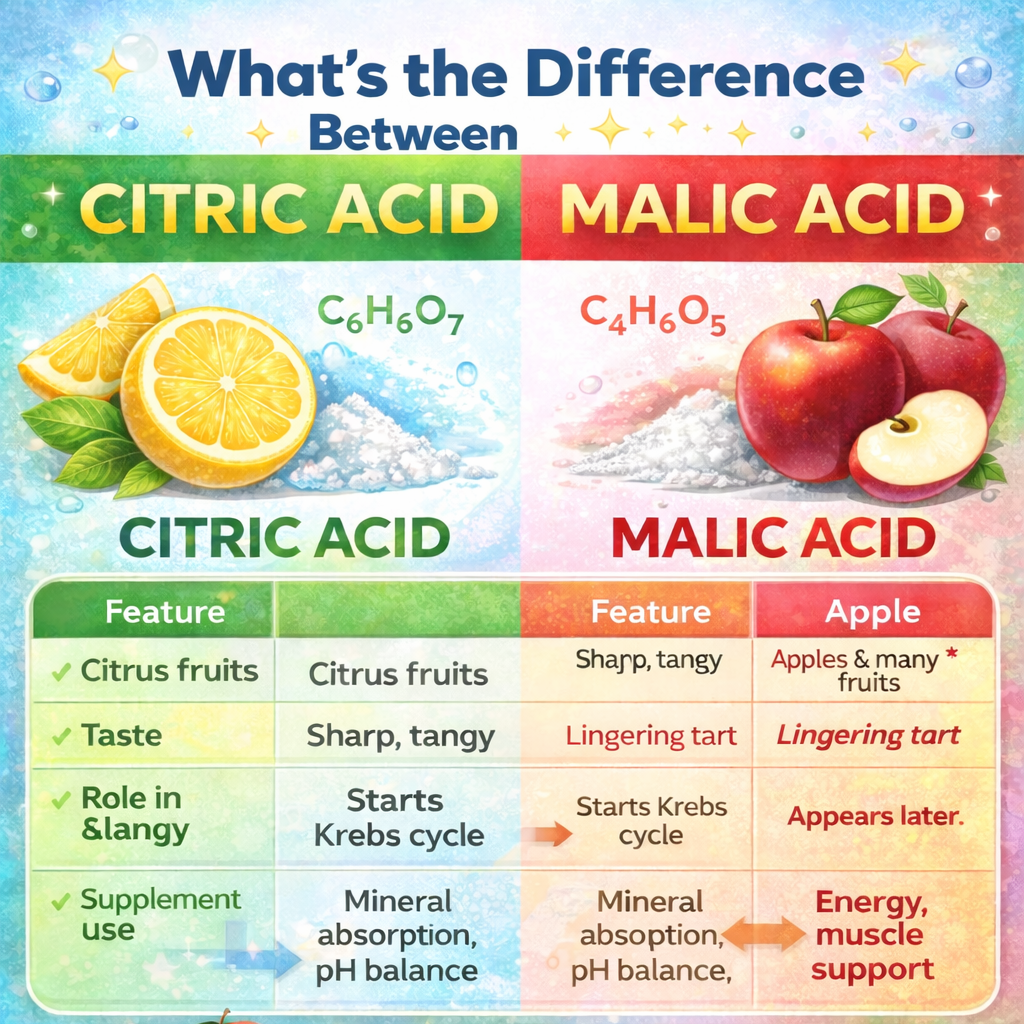
What’s the Difference Between Citric Acid and Malic Acid?
If you’ve ever looked at an ingredient label on a supplement, electrolyte mix, or flavored drink, you’ve probably seen citric acid or malic acid listed. Both are naturally occurring organic acids found in fruits — and both play important roles in human metabolism.
But they are not the same.
Let’s break down the key differences in a simple, practical way.
🍋 What Is Citric Acid?


Citric acid is a natural acid most commonly associated with citrus fruits like lemons, limes, and oranges.
Key Characteristics:
-
Found abundantly in citrus fruits
-
Has a sharp, tangy taste
-
Central to the Citric acid cycle (Krebs cycle)
-
Commonly used as a food preservative and flavor enhancer
What It Does in the Body:
-
Plays a major role in energy production
-
Helps regulate pH balance
-
Enhances mineral absorption when in citrate form
Citric acid is the starting molecule of the energy cycle that powers your cells.
🍏 What Is Malic Acid?
Malic acid is naturally found in apples and many other fruits.
In fact, the word malic comes from the Latin word malum, meaning apple.
Key Characteristics:
-
Gives apples their tart flavor
-
Slightly smoother taste than citric acid
-
Also participates in the Krebs cycle (as malate)
-
Commonly used in supplements for energy and muscle support
What It Does in the Body:
-
Supports ATP (energy) production
-
May help reduce muscle fatigue
-
Plays a role in detox pathways
Malic acid enters the energy cycle later than citric acid but still contributes to cellular energy production.



Dejar un comentario
Este sitio está protegido por hCaptcha y se aplican la Política de privacidad de hCaptcha y los Términos del servicio.